
The PERIVALLON Project, funded by Horizon Europe, unites leading researchers, law enforcement agencies, and technology companies to protect Europe from environmental crime. Illegal dumping, hazardous waste trafficking, and the concealment of dangerous materials not only damage ecosystems but also pose serious risks to public safety and economic stability.
Among the consortium partners, TAMAR Israeli Advanced Quarrying Co. Ltd. (TMR) plays a pivotal role in advancing X-ray imaging and scanning technologies for security and environmental monitoring. Leveraging its domain expertise, TMR contributes not only technology but also practical operational knowledge, ensuring that innovations developed in PERIVALLON can be applied in real-world enforcement contexts.
TMR’s contributions span both technical and operational domains:
- Expert advisory: Advising on scanning methodologies, system design, and operational workflows.
- Technical inputs: Working with partners, TMR helped define cylinder models, object scaling, and optimized scanning approaches for parcels and cargo containers.
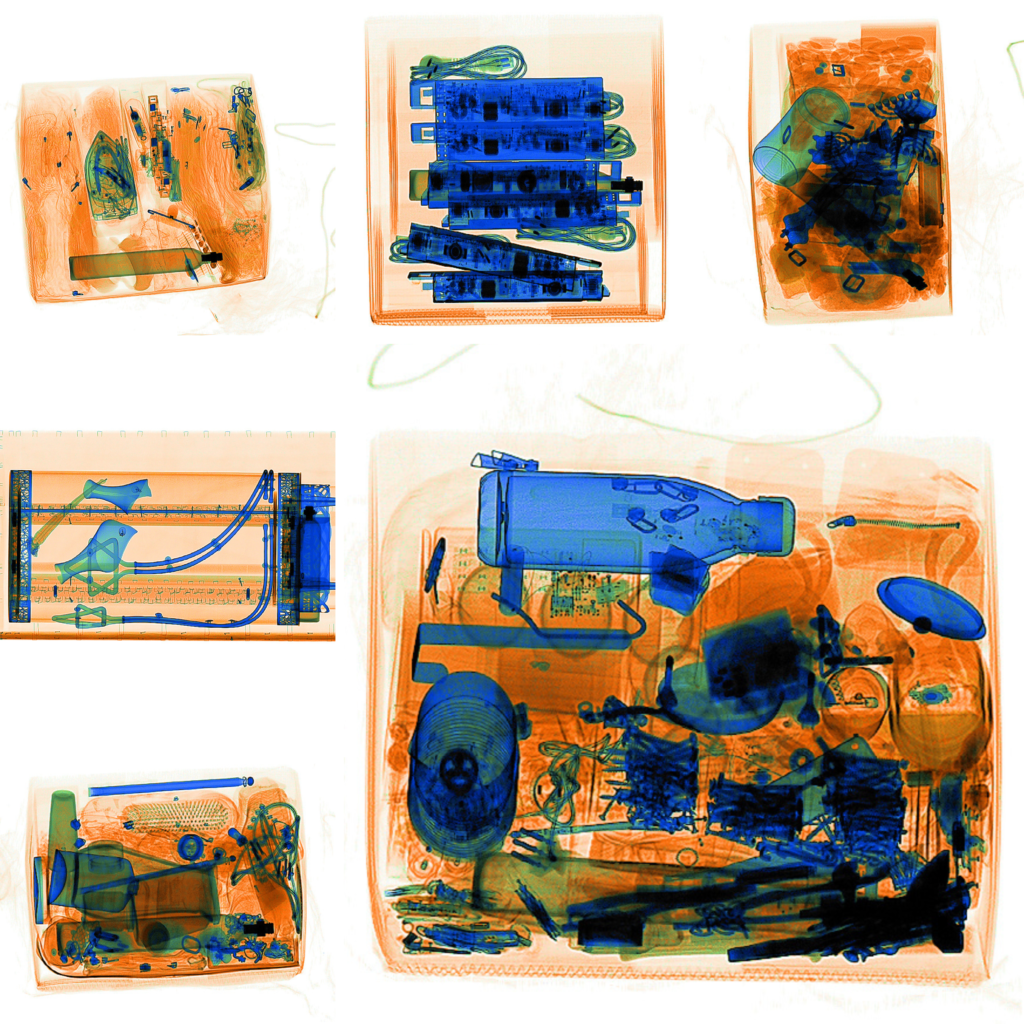
- Data provision: TMR shared real-world X-ray images of cargo parcels with project partners such as DYLOG, enabling the development and validation of AI-driven detection algorithms.
- Policy liaison: TMR engaged in discussions with Israeli authorities regarding operational requirements and deployment strategies for X-ray scanning in parcels and containerized cargo.
These hands-on contributions ensure PERIVALLON’s scanning technologies are both technically advanced and operationally relevant.
The Technical Foundations of X-Ray Imaging
X-ray imaging is based on the principle of attenuation: when an X-ray beam passes through an object, part of the radiation is absorbed or scattered depending on the material’s density, thickness, and atomic number. Measuring the transmitted X-rays allows for a visual representation of the object’s internal structure.
In PERIVALLON, several imaging techniques are explored:
- Single-energy imaging: Produces grayscale projections, where dense materials appear darker. Useful for bulk cargo screening.
- Dual-energy imaging: Acquires two scans at different energy levels, enabling differentiation between organic (plastic, paper), inorganic (glass, ceramics), and metallic substances. This is vital for identifying hazardous materials hidden within legitimate cargo.
- Computed Tomography (CT): Generates 3D reconstructions of scanned objects by rotating the X-ray source around the item. This provides volumetric data, making it easier to detect concealed compartments.
- Backscatter X-ray imaging: Focuses on radiation scattered back from the object, highly effective for detecting low-density organic materials such as explosives or narcotics.
- Spectral imaging: Uses a wider range of X-ray energies to create detailed material signatures, enabling identification of pollutants or toxic compounds.
Scanning Objects: Cylinders, Scaling, and Calibration
One of TMR’s specific contributions to PERIVALLON has been defining object scaling and geometric parameters for scanning systems. This includes:
- Cylindrical calibration models: Using standardized cylinders to test system performance and ensure that scanning outputs are comparable across different machines and conditions.
- Scaling methodologies: Establishing size and density references so that detected anomalies (such as hidden compartments in cargo) can be quantified accurately.
- Object scanning protocols: Designing workflows for how parcels, luggage, or containers are positioned and scanned to maximize detection while minimizing throughput delays.
This work ensures repeatability, interoperability, and accuracy – which are critical for systems that may be deployed across multiple countries and agencies.
AI and Image Processing Integration
Traditional X-ray imaging produces vast amounts of data, but interpretation is often manual and error prone. PERIVALLON partners help address this challenge by integrating artificial intelligence (AI) into the scanning process. Key approaches include:
- Image segmentation: Automatically separating objects within a scan to isolate items of interest.
- Feature extraction: Using algorithms to detect density anomalies, unusual shapes, or material signatures.
- Deep learning classification: Training neural networks on thousands of X-ray images (including those shared by TMR) to recognize concealed threats such as hazardous waste or smuggled goods.
- Anomaly detection: Identifying patterns that deviate from normal cargo profiles, flagging them for human review.
By combining raw imaging with intelligent algorithms, PERIVALLON transforms X-ray scans into actionable intelligence, reducing both false positives and false negatives.
Operational Context: Parcels and Containers
Environmental crimes often exploit global trade routes. Illegal waste shipments are concealed into cargo containers or mislabeled as harmless goods. Parcels may carry hazardous or banned materials.
TMR’s collaboration with Israeli authorities and PERIVALLON partners ensures that scanning technologies are adapted to:
- Parcels: Require high-resolution imaging to detect small but hazardous items. Speed is critical in postal and logistics centers, so AI-based pre-screening plays a major role.
- Cargo containers: Demand high-penetration imaging, often using dual-energy or CT systems, to detect concealed waste or illicit goods. Scalability and automation are key, as thousands of containers move through ports daily.
By providing real cargo scan datasets, TMR bridges the gap between controlled lab conditions and the realities of global trade.
Towards Deployment
The project targets TRL-7 demonstration level, meaning the technologies are validated in controlled, near-operational environments. This means that its scanning methodologies, calibration standards, and datasets will directly influence prototype systems ready for pilot deployment with customs, police, and environmental authorities.
A Safer and Smarter Future
Environmental crime is one of the fastest-growing forms of organized crime, often linked with trafficking networks and financial fraud. By enhancing X-ray imaging with advanced algorithms, calibration methods, and operational insights, TMR and PERIVALLON’s partners ensure that the project delivers tools capable of real-world impact.
Through its contributions – technical definitions, advisory input, scanned datasets, and collaboration with authorities – TMR strengthens Europe’s ability to detect, prevent, and prosecute environmental crimes.
In a world where illicit networks are increasingly sophisticated, TMR’s expertise in X-ray imaging represents a critical step toward smarter security and a greener future.
Written by Nir Haimov, TMR